
 Authorized QIAGEN Distributor in Nepal · JHS Analytic Traders
QIAGEN Rotor-Gene Q.
Rotary geometry. Single optical path. Identical conditions for every well.
Multi-channel fluorescence detection across the UV-to-far-red range, short ramping times, and minimal well-to-well variation for low-copy detection, multiplex panels, and high-resolution melting (HRM). Multiple configurations available — refer to QIAGEN for current channel and HRM options. For research use.
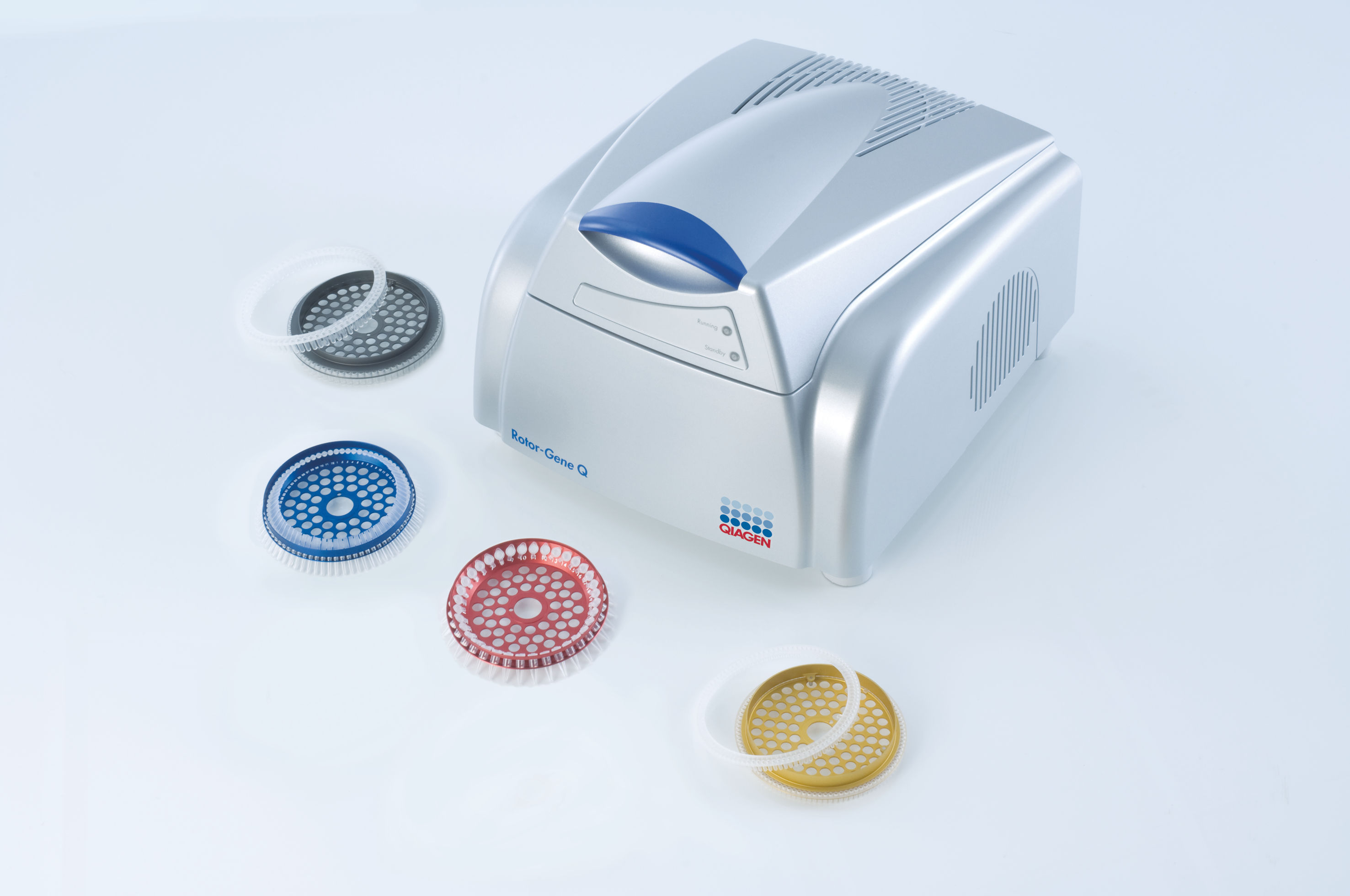
The Rotor-Gene Q uses a rotary carousel format instead of a static block — every tube spins past a single fixed optical assembly each cycle, so fluorescence is measured under identical geometric and thermal conditions for all samples simultaneously. The result is exceptionally low well-to-well variation, critical for accurate quantitation at low copy numbers. Supports multi-channel fluorescence detection across the UV-to-far-red range, short ramp rates, and high-resolution melting (HRM) for sequence variant detection — with interchangeable tube and disc-format rotors. For research use only.
Rotary, not block-based
Samples spin past stationary optics — every well sees identical conditions every cycle.
Multi-channel fluorescence
UV-to-far-red detection across multiple configurations. Match the dyes you multiplex — channel options per QIAGEN specification.
High-resolution melting
Dedicated HRM-capable optics for SNP discrimination, mutation scanning, and methylation analysis.
One detector, one optical path, one airflow
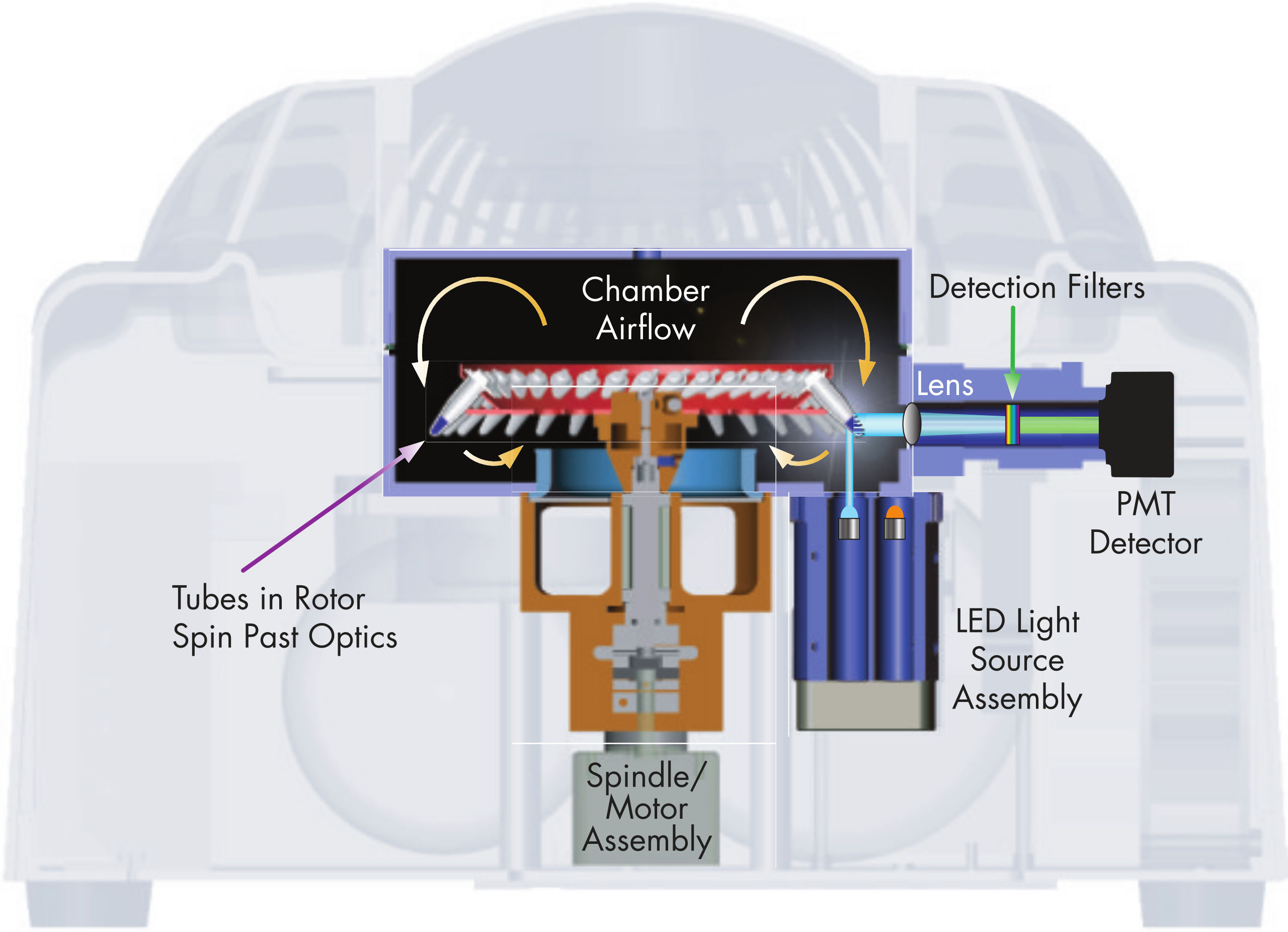
Samples spin past a single LED light source, lens, and PMT detector, while chamber airflow holds every sample at identical temperature — the geometry that delivers the well-to-well uniformity rotary platforms are known for.
Rotary vs. block-based real-time PCR
| Rotor-Gene Q (Rotary) | Conventional Block-Based qPCR | |
|---|---|---|
| Throughput per run | Interchangeable tube and disc-format rotors (refer to QIAGEN datasheet for current rotor options) | Typically fixed block-format wells |
| Well-to-well uniformity | Identical thermal & optical conditions for every well | Edge effects and thermal gradients possible |
| Optical path | Single excitation source, single detector — no cross-talk | Multiple optical paths, calibration-dependent |
| Ramping speed | Rapid — small thermal mass, forced air convection | Variable; depends on Peltier element thermal mass |
| Maintenance | No optical alignment / calibration; LED light source | Lamp/laser replacement, periodic optical alignment |
Reference Lab Integration in Nepal
Best positioned for research, university, and reference laboratories in Nepal — medical colleges, virology and microbiology reference labs, and pharma R&D running validated PCR methods. JHS supplies the instrument across Kathmandu, Pokhara, Biratnagar, and the rest of Nepal, together with the QIAGEN reagent ecosystem (Rotor-Gene Multiplex PCR Kit, QuantiTect, QuantiFast, Type-it HRM). Service, training, and validation scope confirmed at quotation. For clinical syndromic diagnostics, see QIAstat-Dx.
Applications & research use cases
Gene Expression Analysis
Quantitative measurement of mRNA expression — relative or absolute quantitation for transcriptomics, drug response, and developmental biology research.
Pathogen Detection
Multiplex pathogen identification — viral and bacterial assays for research, surveillance, and outbreak investigation in reference labs.
DNA Methylation Analysis
Methylation-specific PCR for epigenetic research — supports QIAGEN's EpiTect kits and other methylation-targeted workflows.
High-Resolution Melting (HRM)
Sequence variation analysis — SNP genotyping, mutation scanning, and methylation status detection through post-PCR melt-curve analysis.
Genotyping & SNP Detection
Allelic discrimination and SNP genotyping for population studies, pharmacogenomics, and research genotyping projects.
Pharmaceutical & Industrial QC
Validated PCR-based methods for pharmaceutical quality control, contamination testing, and biomanufacturing process monitoring.
Rotor-Gene Q is part of JHS's QIAGEN Portfolio.
Authorized QIAGEN distributor for clinical and research molecular diagnostics — delivering complete workflows from extraction to detection.
Product documentation & media
Manufacturer walkthrough showing the core workflow, instrument modularity, and key operating steps.
Which Rotor-Gene Q configurations are available?
QIAGEN offers the Rotor-Gene Q in multiple channel configurations, with and without dedicated HRM optics. JHS configures the right model based on the assays you need to run, the number of dyes you multiplex, and whether HRM is in your workflow — please contact us for the current QIAGEN configuration list and pricing.
Why does the rotary format matter?
Conventional real-time PCR uses a fixed thermal block where samples in different well positions can experience small thermal gradients and different optical paths to the detector. The Rotor-Gene Q rotates samples (typically 36 to 100 wells) at high speed past a single excitation source and a single detector, so every sample sees identical conditions every cycle. This delivers exceptional well-to-well thermal and optical uniformity — particularly important for low-copy detection, multiplex panels, and HRM where signal differences are small.
Is the Rotor-Gene Q WHO-prequalified or FDA-cleared for clinical diagnostics?
No. The Rotor-Gene Q (research version) is for research use only and is not WHO-prequalified or FDA-cleared for clinical diagnostic use. QIAGEN offers a separate Rotor-Gene Q MDx platform in regulated markets that carries IVD marking. For syndromic infectious disease diagnostics, see QIAstat-Dx. For TB-specific molecular testing, current WHO prequalification covers only dedicated TB platforms from other manufacturers.
Does JHS provide installation, training, and reagent supply?
Yes. As QIAGEN's authorized distributor in Nepal, JHS Analytic Traders supplies the Rotor-Gene Q together with the full QIAGEN reagent ecosystem (Rotor-Gene Multiplex PCR Kits, QuantiTect kits, QuantiFast kits, primer assays, Rotor-Discs and tubes) through manufacturer-authorized channels. Specific service scope, operator training, validation documentation, and warranty terms are confirmed per project at the quotation stage to match your lab's accreditation and SOP requirements.