 Dumas combustion analysis
VELP NDA 702 Dumas Nitrogen Analyzer
From prepared sample to total nitrogen result in a single automated combustion cycle.
The NDA 702 automates Dumas combustion analysis for laboratories testing food, feed, soil, fertilizer and other organic matrices. It combines high-temperature combustion, gas treatment, separation and thermal-conductivity detection in one programmed workflow.
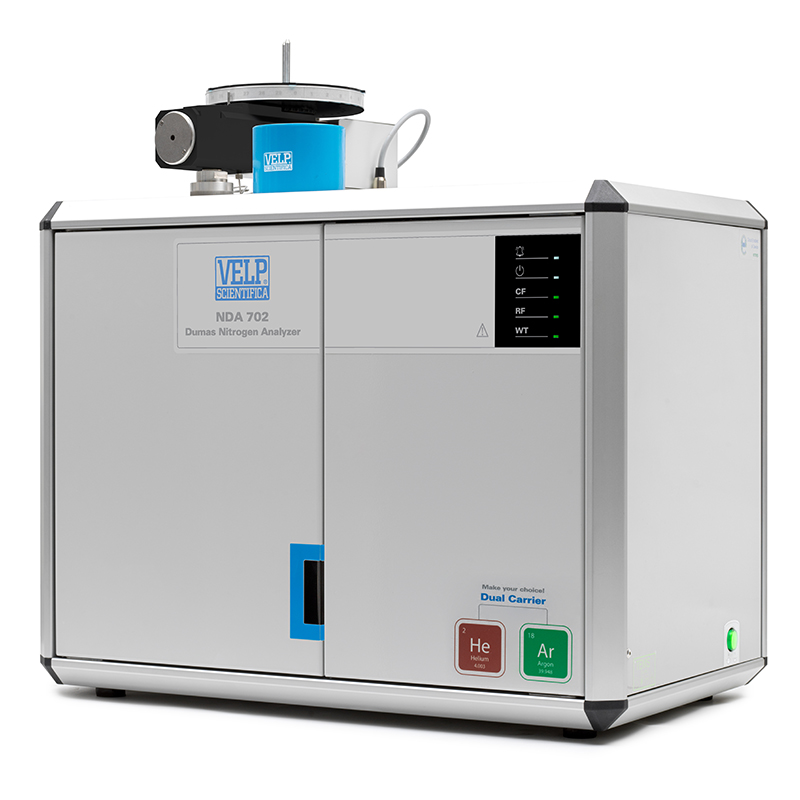
The instrument reports total nitrogen directly. For protein methods, the software applies the appropriate conversion factor defined by the laboratory. VELP specifies helium or argon as carrier-gas options, an expandable electronic autosampler, and connectivity for routine data handling. Final configuration should always be matched to sample type, expected nitrogen range, throughput and the standard operating procedure.
Minutes, not hours
A programmed combustion cycle turns routine nitrogen and protein testing around far faster than traditional wet-chemistry workflows.
Helium or argon carrier gas
The NDA 702 can be configured for either carrier gas, which matters where helium supply is uncertain.
Unattended sequences
The electronic autosampler takes additional discs, so a batch can run without an operator at the bench.
NDA 702 at a glance
What the platform is and how it is configured. Performance figures — analysis time, sample weight, detection range, recovery and precision — are published by VELP in the brochure below, and real method performance still depends on representative sampling, homogenization, calibration and ongoing quality control.
A fully programmed combustion workflow
The Dumas method converts nitrogen in the prepared sample into a measurable gas signal. Unlike Kjeldahl digestion, the routine analytical cycle does not use concentrated acid digestion or steam distillation.
Weigh the sample
A representative, homogenized portion is sealed in the suitable sample container and loaded into the autosampler.
Oxidize at high temperature
The sample is combusted in oxygen at the programmed high temperature, converting nitrogen compounds into gaseous products.
Treat and separate gases
The gas stream is processed so interfering components are removed and nitrogen reaches the detector under controlled conditions.
Measure by TCD
The thermal-conductivity detector quantifies nitrogen against calibration, and the software calculates the reported result.
One analyzer across food and agricultural laboratories
One combustion principle covers a wide spread of matrices, which is why a single analyzer can serve a food lab, a feed mill and a soil department at once. What changes between them is sample preparation, the calibration you run against, and the protein factor applied when crude protein is the reported figure.
Food, grain & dairy
Total nitrogen and calculated crude protein in cereals, flour, milk products, meat and processed foods — the routine protein number behind most food QC releases.
Animal feed
Routine crude-protein determination in feed ingredients, compound feeds and pet-food materials for quality and formulation control.
Soil & plant material
Total nitrogen measurement in prepared soil, compost and plant tissue for agronomy, research and nutrient-management studies.
Fertilizer & environmental samples
Nitrogen content in fertilizer blends and environmental samples, where the result feeds a compliance figure or a product declaration.
Specifications that belong in the procurement brief
A useful specification does more than repeat a brochure. It connects the instrument configuration to your samples, gas availability, expected workload, reporting rules and applicable reference methods.
| Parameter | VELP NDA 702 published information | Why it matters |
|---|---|---|
| Analytical method | Dumas combustion with thermal-conductivity detection | Determines total nitrogen; protein is calculated using the chosen conversion factor. |
| Analysis time | See VELP brochure | Helps estimate daily throughput and autosampler requirements. |
| Sample weight | See VELP brochure | The working mass must suit sample homogeneity and expected nitrogen concentration. |
| Carrier gas | Helium or argon | Gas selection affects installation planning, supply continuity and operating cost. |
| Autosampler | Electronic, expandable with additional discs | Supports unattended sequences and mixed routine workloads. |
| Connectivity | Wi-Fi or LAN for Ermes, plus USB and RS232 | Defines remote monitoring and data-transfer options for the planned laboratory workflow. |
| Data integrity | Optional 21 CFR Part 11 package | Should be specified before purchase when controlled electronic records are required. |
| Reference methods | Includes relevant ISO 16634, ISO 14891, AOAC, AACC and ICC applications | The exact standard must match the matrix and reporting purpose. |
Plan the analyzer and its utilities as one system
A Dumas analyzer is not a bench-top purchase you plug in and forget. It runs on a carrier gas and oxygen, which means cylinders, regulators and a resupply arrangement that has to hold in Kathmandu — the gas plan is usually the thing that delays a commissioning, not the instrument. Room conditions, exhaust, power, sample preparation and reference materials belong in the same conversation. JHS can coordinate the required NDA 702 configuration with VELP and define installation, training and documentation scope for the project.
VELP documentation for the NDA 702
VELP's walkthrough of the automated combustion cycle — weighing, loading, analysis and read-out. Filmed on the NDA 701, the model the NDA 702 succeeded; the method and the workflow are the same.
A Dumas system configured around your real sample load
Tell us what you test, the expected nitrogen range, samples per day, preferred carrier gas, applicable standard and reporting requirements. That information allows the analyzer, autosampler, gas setup, consumables and software options to be quoted as one practical system. Laboratories building a broader composition workflow can also compare our TOC analyzers and moisture balances.
VELP NDA 702 in Nepal
What does the VELP NDA 702 measure?
The NDA 702 determines total nitrogen by the Dumas combustion method. With the appropriate protein factor, software can express the result as crude protein for food and feed workflows.
How long does one NDA 702 analysis take?
Analysis time is published by VELP in the NDA 702 brochure and depends on the sample and method. Download it below for the current figure.
Can the NDA 702 operate with argon instead of helium?
Yes. VELP specifies helium or argon, grade 4.5, as carrier-gas options for the NDA 702. The final installation must be configured for the chosen gas.
What sample size can the NDA 702 analyze?
Sample weight is specified by VELP in the NDA 702 brochure. The correct mass depends on sample type, nitrogen concentration, homogeneity and the validated method.
How many samples can the autosampler hold?
The electronic autosampler takes additional discs to extend a run. VELP publishes the exact capacity in the NDA 702 brochure.
What should be provided for an NDA 702 quotation in Nepal?
Tell us what you actually test and how much of it per day, which standard you report against, and whether helium or argon suits your supply situation. Those answers size the autosampler and settle the gas configuration, which are the two decisions that are awkward to change later.