 Featured supplier · Authorized Waters Distributor in Nepal · JHS Analytic Traders
HPLC + UPLC for Pharma QC, Analytical, and Research Labs.
Two platforms, two jobs. Compendial release on one. Method development on the other.
Liquid chromatography is the workhorse separation technique for pharmaceutical assay, food and environmental analysis, clinical bioanalysis, and academic research. JHS supplies Waters liquid chromatography systems for Nepal — the Alliance HPLC for compendial QC workflows, and the ACQUITY UPLC for high-resolution research, complex separations, and method development.
Every peak captured. Every signature secured.
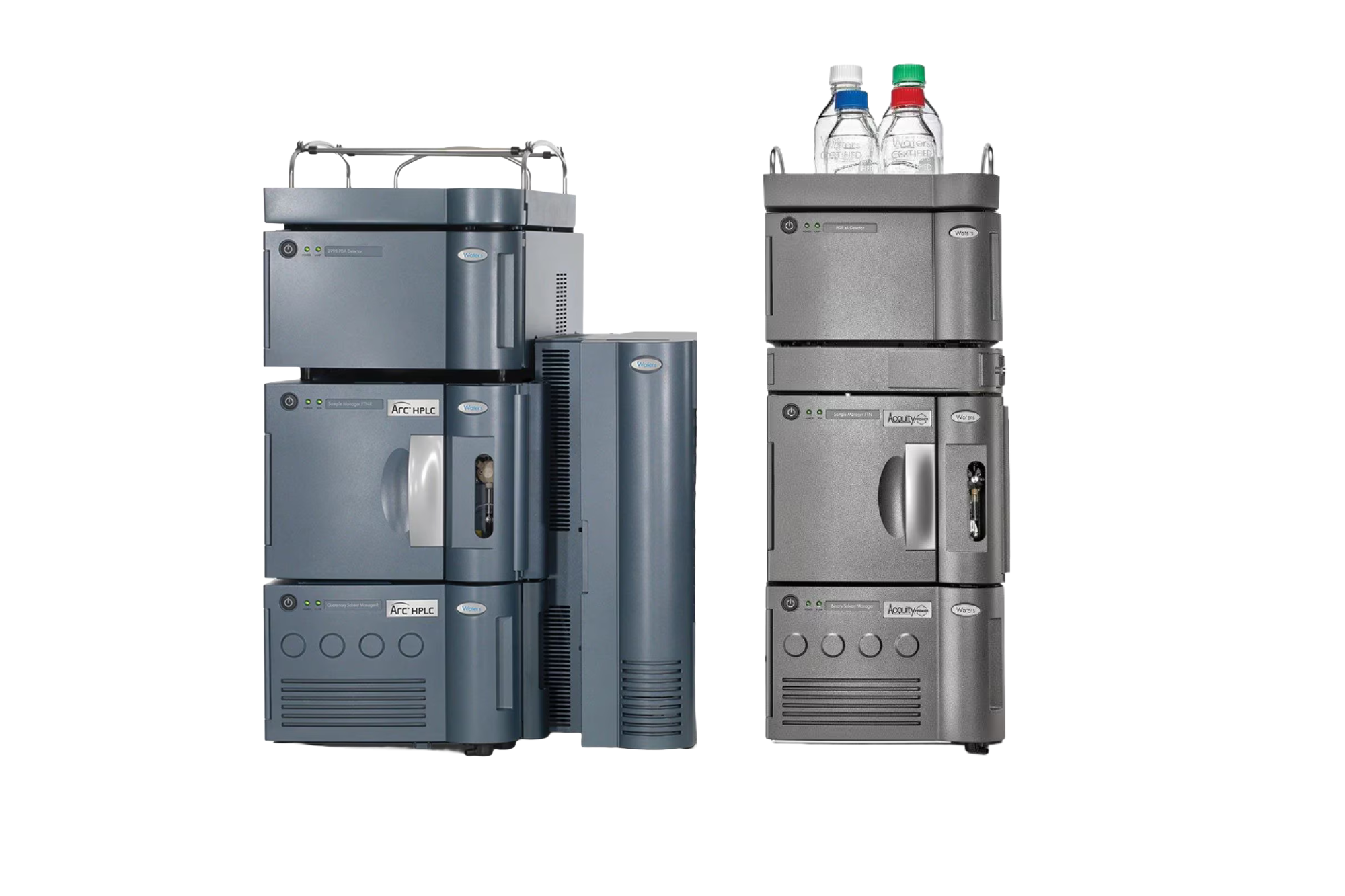
At the top of the Waters Alliance HPLC stack: the detector and column compartment — UV, PDA, fluorescence, or refractive index, whichever the method calls for. The signal flows directly into Empower CDS, the chromatography data system standard across regulated pharma — audit trails, e-signatures, locked validated method states, and 21 CFR Part 11–supportive records behind every confident batch release.
Every injection, exactly the same.
Mid-stack sits the Alliance Sample Manager — the autosampler Nepal pharma analysts trust for assay, content uniformity, dissolution, and related-substances batches. Method-defined volumes drawn vial after vial at the low-ppm carryover Waters publishes, with pre-injection diagnostics confirming vial position, sample volume, and needle seal before each run. The unattended overnight batch that lands first-time-right.
The pump that holds your gradient.
At the foundation of the Alliance HPLC: the quaternary solvent management module. Up to four mobile phases blended to the composition your USP, BP, or IP method specifies, held across extended unattended batches. Inline vacuum degassing strips dissolved oxygen before the first microlitre reaches the column — the repeatability behind every compendial chromatogram a Nepal pharma QC lab signs off.
Smaller particles, higher pressure — UPLC's design point.
At the top of the Waters ACQUITY UPLC: the Binary Solvent Manager — the high-pressure pump driving the smaller-particle, higher-pressure regime UPLC was designed for. That's the operating window UPLC was built for, where the assay calls for fast cycles, sharper peaks for MS coupling, and the resolution complex separations need. A different platform for a different job — not a replacement for compendial HPLC.
A flow path engineered for clean recovery.
Mid-stack sits the ACQUITY Sample Manager — and the Premier variant changes the recovery story. Conventional UPLC flow paths are stainless steel; metal-sensitive analytes (phosphopeptides, oligonucleotides, organic acids, glycans, phospholipids) interact with that surface. Premier replaces every metal contact with Waters' MaxPeak HPS barrier layer — those analytes recovered cleanly from the first injection. No passivation. No conditioning.
Sharper data. Methods that travel.
At the base: the ACQUITY detector and column compartment, where every advantage of the stack lands as data. Lower limits of detection. Recovery that holds across analyst handoffs and column lots. Peak shape that transfers cleanly between R&D and QC. JHS Analytic Traders — Waters' authorized distributor in Nepal — supplies the Alliance HPLC, ACQUITY UPLC, and Waters columns; configuration and service scope confirmed at quotation.
From mobile phase to certified chromatogram.
Six modules across the Alliance HPLC and ACQUITY UPLC — Waters' two flagship liquid chromatography platforms.
Every peak captured. Every signature secured.
At the top of the Alliance HPLC stack: the detector and column compartment. UV, PDA, fluorescence, or refractive index — whichever the method calls for — the signal flows directly into Empower CDS, the Waters chromatography data system standard across regulated pharma. Audit trails, e-signatures, locked validated method states; 21 CFR Part 11–supportive records behind every confident batch release.
Every injection, exactly the same.
Mid-stack: the Alliance Sample Manager. Method-defined injection volumes drawn vial after vial at the low-ppm carryover Waters publishes for the platform. Pre-injection diagnostics confirm vial position, sample volume, and needle seal before the run begins — the unattended overnight batch that lands first-time-right.
The pump that holds your gradient.
At the foundation: the quaternary solvent management module. Up to four mobile phases blended to the composition your USP, BP, or IP method specifies and held across extended unattended batches, with inline vacuum degassing pulling dissolved oxygen out before the first microlitre reaches the column.
Smaller particles, higher pressure — UPLC's design point.
The ACQUITY UPLC Binary Solvent Manager drives the smaller-particle, higher-pressure regime UPLC was designed for — the operating window where the assay calls for fast cycles, sharper peaks for MS coupling, and the resolution complex separations need. A different platform for a different job — not a replacement for compendial HPLC, where Alliance remains the workhorse.
A flow path engineered for clean recovery.
Conventional UPLC flow paths are stainless steel, and metal-sensitive analytes — phosphopeptides, oligonucleotides, organic acids, glycans, phospholipids — interact with that surface in ways that suppress recovery. The ACQUITY Premier variant replaces every metal contact surface with Waters' MaxPeak HPS barrier layer, returning those same analytes cleanly from the first injection — no passivation, no overnight conditioning.
Sharper data. Methods that travel.
Lower limits of detection, recovery that holds across analyst handoffs and column lots, and peak shape that transfers cleanly between R&D and QC — chromatography that earns its place at the centre of your method portfolio. JHS Analytic Traders, Waters' authorized distributor in Nepal, supplies the Alliance HPLC, ACQUITY UPLC, and Waters columns; configuration and service scope confirmed at the quotation stage.
HPLC and UPLC — what each platform is built for.
| HPLC (Waters Alliance family) | UPLC (Waters ACQUITY family) | |
|---|---|---|
| Operating pressure | Conventional | Higher (per Waters specifications) |
| Column particle size | Standard packing | Smaller particles (per Waters specifications) |
| Run time per sample | Per compendial method requirements | Faster cycle by design |
| Resolution / peak shape | To compendial monograph requirements | Designed for co-eluting peaks and MS coupling |
| Sensitivity | Matched to compendial method limits | Narrower peaks concentrate the detector signal |
| Compendial method transfer | Direct — USP / BP / IP methods written for HPLC | Possible but requires re-validation |
| Capital cost | Lower | Higher |
| Solvent consumption | Per compendial method | Lower per sample (smaller column volume) |
| Built for | Pharma QC release, routine validated methods, GMP environments | R&D, method dev, complex separations, MS-coupled, high-throughput |
Pharma QC & Research Labs in Nepal
For Nepal's pharmaceutical manufacturers — both those supplying the domestic GMP-regulated market and those exporting to international regulated markets — liquid chromatography is the central technique behind release testing, stability, dissolution, assay, content uniformity, and related-substances analysis. The Waters Alliance HPLC is built for this work; the ACQUITY UPLC opens up the high-resolution separations and faster cycles that conventional HPLC cannot reach for analytical chemistry, food testing, water quality, clinical bioanalysis, and university research. JHS supplies both platforms — plus the Waters columns and consumables ecosystem — across Kathmandu, Lalitpur, Pokhara, Biratnagar, Birgunj, Butwal, and the rest of Nepal.
Applications & Industry Use Cases
Pharmaceutical QC
Release testing, assay, dissolution, content uniformity, related substances — compendial methods (USP, BP, IP) on Alliance HPLC with Empower CDS.
Stability Studies & Impurity Profiling
Forced-degradation studies, stability-indicating methods, complex impurity separations — UPLC's higher resolution distinguishes co-eluting degradants.
Food & Beverage Testing
Vitamin assays, additive quantification, mycotoxin screening, residual pesticide analysis — both HPLC and UPLC for routine food safety labs.
Water & Environmental Analysis
Pesticide residues, pharmaceutical micropollutants, organic contaminant screening — UPLC-MS coupling for trace-level detection.
Clinical Bioanalysis
Therapeutic drug monitoring, metabolite quantitation, biomarker analysis in plasma / serum / urine — UPLC-MS for sensitivity-critical bioanalytical methods.
Academic & Research Labs
Method development, fundamental separations research, training next-generation analytical chemists — both platforms for university chemistry, pharmacy, and life sciences departments.
HPLC + UPLC Is Part of JHS's Waters Portfolio.
Authorized Waters distributor across the chromatography range — instruments, columns, detectors, and CDS — for complete chromatography labs.
Product documentation & media
Should our lab choose HPLC or UPLC?
Choose HPLC if you run validated compendial methods (USP, BP, IP), need GMP-friendly method transfer, or your application is method-driven QC where reproducibility matters more than speed. Choose UPLC if you run complex separations with co-eluting peaks, need sub-minute high-throughput cycling, are doing method development that benefits from sharper peaks and higher sensitivity, or your downstream detector is mass spec where peak shape directly affects sensitivity. Many pharmaceutical labs run both: HPLC for routine release testing, UPLC for impurity profiling and stability studies.
Are these systems suitable for pharmaceutical QC labs in Nepal?
Yes. The Waters Alliance HPLC is purpose-designed for regulated QC environments — built for compendial methods (USP, BP, IP, JP), Empower CDS integration, audit trails, electronic records, and the reproducibility required by Nepal's pharmaceutical manufacturers operating under DDA GMP for the domestic market and to international export standards alike. The ACQUITY UPLC suits R&D, stability studies, and impurity profiling where higher resolution and sensitivity matter. Both platforms are routinely deployed across Asian pharmaceutical QC labs running validated dissolution, assay, content uniformity, and related-substances methods.
What about HPLC columns and consumables?
HPLC and UPLC columns are consumables with finite lifespans (typically 1,000–3,000 injections depending on chemistry, sample type, and use intensity), replaced regularly by analytical chemists based on injection count and method requirements. JHS supplies HPLC columns separately — Waters columns and other compatible chemistries — through our dedicated HPLC Column page. Universal connection fittings mean labs are not brand-locked: a Waters instrument accepts columns from multiple manufacturers based on which chemistry performs best for the separation.
Does JHS provide installation, training, and method support?
Yes. As Waters' authorized distributor in Nepal, JHS Analytic Traders supplies the Alliance HPLC and ACQUITY UPLC systems through manufacturer-authorized channels. Specific service scope, IQ/OQ/PQ documentation, operator and method training, Empower CDS configuration, column starter packs, and warranty terms are confirmed per project at the quotation stage to match your lab's regulatory and method requirements.
Can the systems be used with mass spectrometry?
Yes. Both Alliance HPLC and ACQUITY UPLC support coupling to mass spectrometric detection — particularly relevant for clinical bioanalysis, environmental trace analysis, and pharmaceutical impurity work. UPLC's sharper peak shapes specifically benefit MS sensitivity (narrower peaks concentrate the signal). MS configuration confirmed at the quotation stage based on your application.