
 J-Series digital refractometers
Rudolph Research Digital Refractometers
Select the optical range, accuracy, temperature control and software around the sample, not around a generic model name.
The Rudolph Research J-Series covers routine food and beverage testing through demanding pharmaceutical, chemical, petroleum and analytical applications. Its digital internal-reflection design measures refractive index, Brix and configured concentration scales without visual shadow-line interpretation.
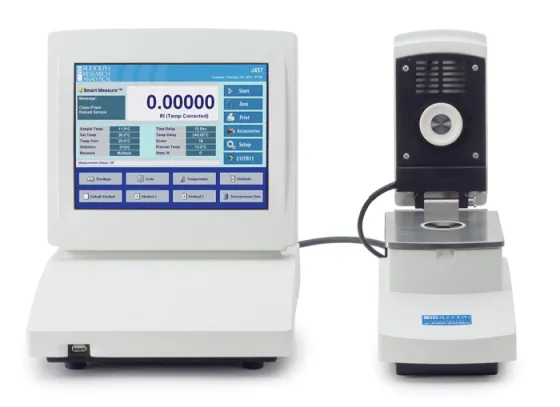
A refractometer is only as suitable as its selected range, accuracy and temperature capability. Rudolph's J-Series is therefore presented here as a model family rather than as one universal instrument. Higher-end configurations add broader measurement ranges, more advanced temperature control, custom scales and data-integrity options. JHS can match those choices to the laboratory's actual samples and reporting requirements.
Internal-reflection measurement
The detector interprets the optical response electronically, avoiding the manual shadow-line reading used by traditional visual Abbe instruments.
Artificial sapphire prism
Rudolph uses a flat, durable sapphire prism surface designed for straightforward sample application and cleaning.
Temperature control to match the method
Refractive index moves with temperature, so the reading is only as stable as the sample's temperature. The J-Series spans simple correction through to active Peltier control — how tightly your method holds temperature decides which end you need.
Specify what the method needs first
Refractive index is sensitive to both composition and temperature. A sound purchase brief therefore starts with the matrix, expected range, required accuracy and reference temperature, then adds workflow and data requirements.
Choose the J-Series around the application
The J-Series is a family, not a single instrument. Four things separate the models: optical range, accuracy, how temperature is handled, and what the software has to record. Below is where each one sits — the selection guide carries the exact figures.
| Model family | Published positioning | Typical selection reason |
|---|---|---|
| J47 | Entry-level food and beverage refractometer, offered in application-oriented ranges | Routine Brix or refractive-index work where temperature correction fits the method. |
| J57 | Food and beverage model with actual temperature control | Better consistency when samples must be measured at a defined temperature. |
| J157 | Higher-accuracy food and water-based chemical applications, with extended temperature capability | Methods needing stronger accuracy, controlled temperature and custom scales. |
| J257 | Broad-range platform for polymers, petroleum, chemical and pharmaceutical work | Laboratories that test matrices extending beyond routine aqueous food samples. |
| J357 | Pharmaceutical, chemical, petroleum, essential-oil and fragrance applications | Advanced laboratory workflow, with a 21 CFR Part 11 software option where required. |
| J457 | Most configurable J-Series platform, including a split-instrument design | Demanding pharmaceutical and analytical laboratories needing a highly tailored system. |
A controlled reading starts before the sample touches the prism
Digital measurement removes subjective shadow-line interpretation, but reliable results still depend on cleanliness, calibration, temperature equilibrium and a representative sample.
Clean and verify
Clean the sapphire prism, inspect it for residue and perform the required verification or calibration using the defined reference material.
Load the sample
Cover the prism completely with a representative sample. Trapped air, evaporation and carry-over from the last sample are what usually sit behind a reading that will not settle.
Control temperature
Allow the sample to reach the method temperature using the selected model's correction or active temperature-control capability.
Measure and report
The instrument calculates refractive index, Brix or the configured scale and records the result according to the laboratory procedure.
Refractive-index control across regulated and industrial laboratories
A refractometer can support identity, concentration or process-control decisions when the measurement range, accuracy, temperature and validated method fit the sample.
Pharmaceutical QC
Refractive-index testing of liquid raw materials, intermediates and formulated products, with higher-end software options where controlled records are required.
Food & beverage
Brix and concentration checks for juices, syrups, soft drinks, dairy products, honey, sauces and process streams.
Chemical & petroleum
Refractive-index and concentration measurement for solvents, water-based chemicals, petroleum samples and compatible process materials.
Essential oils & cosmetics
Identity and quality checks for essential oils, fragrances, flavors, cosmetics and related materials within the chosen model's range.
Why laboratories move beyond a manual Abbe reading
A traditional Abbe refractometer asks the operator to view and align a shadow line. A Rudolph digital refractometer detects the internal-reflection boundary electronically. This can reduce operator subjectivity, support dark samples and make results easier to store, repeat and integrate into a controlled workflow.
| Decision point | Digital J-Series approach | Procurement question |
|---|---|---|
| Reading | Electronic detection and numerical result | What accuracy and resolution does the method require? |
| Dark samples | No visual shadow-line interpretation is required | Are samples opaque, strongly colored or difficult to judge visually? |
| Temperature | Correction or electronic control depending on model | At what temperature must the result be reported? |
| Cleaning | Flat artificial sapphire prism surface | Are samples sticky, volatile, corrosive or difficult to remove? |
| Scales | Brix and application-specific scales depending on configuration | Is direct concentration reporting required, and against which method? |
| Records | Workflow and compliance options vary by platform | Are user controls, audit trails or 21 CFR Part 11 functions required? |
Match the refractometer to the sample before quotation
For a refractometer in Nepal, provide the sample names rather than requesting only a broad refractive-index range. The model decision should include the expected value, required accuracy, reference temperature, viscosity, color, cleaning compatibility, daily workload, scales and data-integrity needs. JHS can then coordinate the suitable Rudolph J-Series platform, accessories, standards and project documentation.
Compare the Rudolph J-Series
An official overview of the J-Series range and the application differences that should guide model selection.
One J-Series family, selected for your method
Send the sample list, expected range, accuracy target, measurement temperature, daily throughput and software requirements. JHS can use that information to narrow the J-Series choice and prepare a configuration that is technically meaningful for the laboratory. For adjacent optical methods, compare our polarimeters and UV-Vis spectrophotometers.
Rudolph refractometers in Nepal
What does a Rudolph digital refractometer measure?
Rudolph J-Series instruments measure refractive index and can report Brix or application-specific concentration scales when the selected model and method support them.
Which Rudolph J-Series model should a laboratory choose?
Start from the sample, not the model number. What you measure sets the range you need; how tightly the method is written sets the accuracy and whether temperature has to be actively controlled; and if the result lands in a regulated record, that decides the software. Those three answers usually narrow the family to one or two models.
Can Rudolph refractometers measure dark samples?
Yes. Rudolph describes the digital internal-reflection optical design as suitable for dark samples because it does not rely on visual shadow-line interpretation.
Why is temperature control important in refractive-index measurement?
Refractive index changes with temperature. A model with suitable electronic temperature control can improve consistency by measuring at a defined temperature. Available temperature capability varies by J-Series model.
Are 21 CFR Part 11 options available?
Yes, on the higher-end J-Series configurations — Rudolph offers 21 CFR Part 11 software for them. It is not standard across the whole family, so if you keep electronic records under GMP, say so at enquiry: it rules several models out straight away.
What should be provided for a refractometer quotation in Nepal?
Name the actual samples rather than asking for a general range. With the samples, the accuracy your method demands, the temperature you measure at, roughly how many readings a day, and whether the data has to be audit-trailed, the model choice is usually obvious.