
 Palintest · Water Testing Partner · Nepal
Palintest Wagtech Potatest.
Membrane filtration. On-site coliform counts. Drinking-water decisions in the field.
A portable, field-ready microbiological water testing kit — bringing coliform counts, chlorine, pH, and turbidity out of the lab and to the water source. Part of the Palintest Wagtech range.
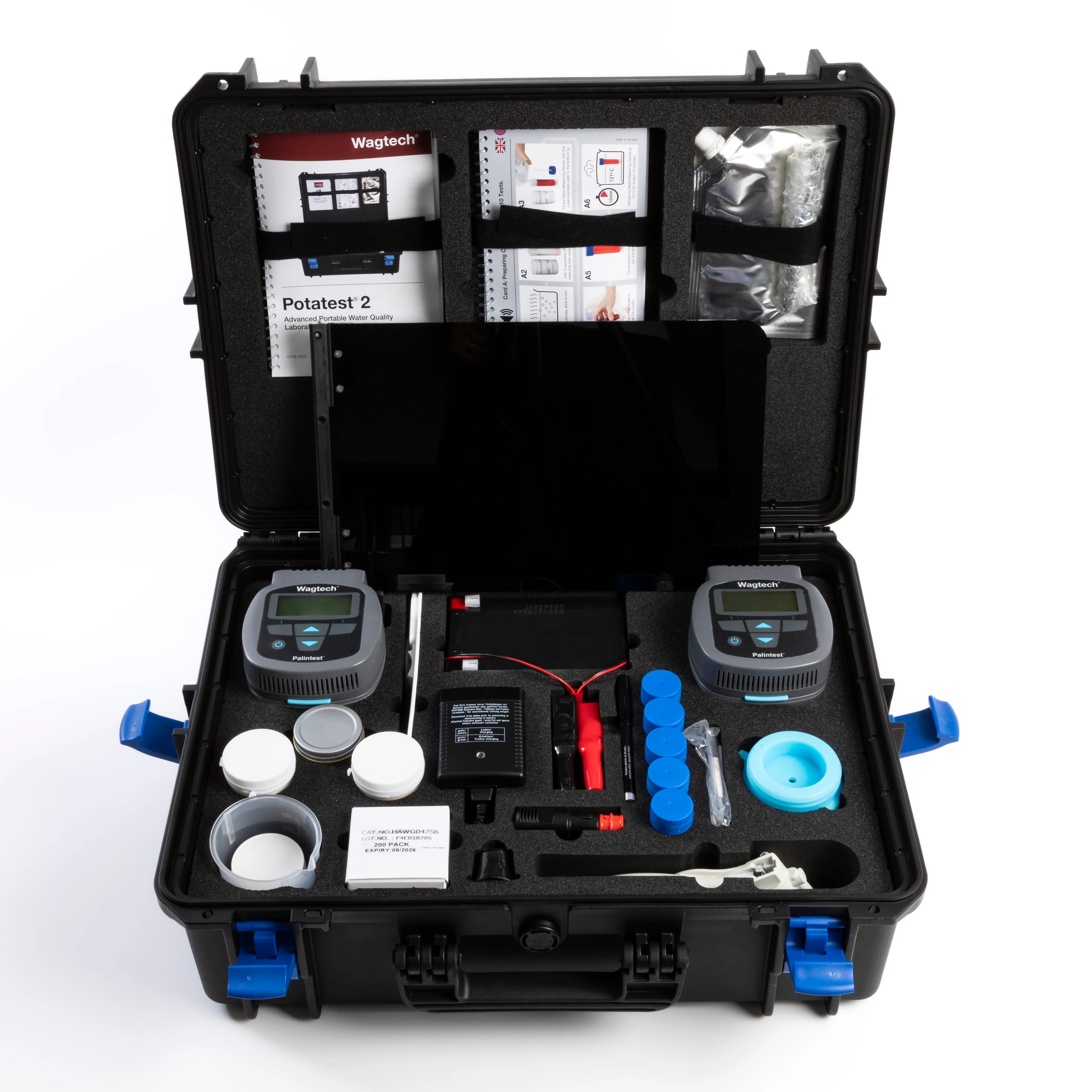
JHS Analytic Traders supplies the Palintest Wagtech Potatest across Nepal — a portable, field-ready microbiological water quality testing kit that brings laboratory-grade analysis out of the lab and into the field. Developed by Palintest, a Halma Company and one of the world's leading names in water analysis, the Potatest lets teams confirm whether a water source is safe to drink — right where it's needed.
On-site microbiology
Culture-based water-quality testing carried out in the field, without shipping samples back to a laboratory.
A microbiology lab in a carry case
Self-contained and portable — no fixed laboratory or sample transport. Built for boreholes, rivers, and tankered water tested at the point of use.
Answers you can act on
Biological indicators alongside free/total chlorine, pH, and turbidity — the core parameters for verifying drinking-water safety and disinfection, in line with WHO water-safety guidance.
The measurements that decide if water is safe to drink
The Potatest covers the parameters most critical for drinking-water safety verification — total and faecal coliforms as the primary indicators of biological contamination, alongside free and total chlorine to confirm disinfection has been effective, plus pH and turbidity. Coliforms are measured by membrane filtration with on-site incubation; chlorine, pH, and turbidity are read in the field.
Certainty, carried to the source.
The Potatest takes water testing out of the laboratory and to the source — boreholes, rivers, tankered supplies — so teams can decide, on the spot, whether water is fit to provide. For the full testing methodology and specifications, refer to Palintest's product documentation.
Testing water where it is actually consumed
Emergency & Disaster Response
Assess boreholes, rivers, and tankered water after earthquakes, floods, or displacement — deciding quickly whether a source is safe to provide as drinking water.
NGO & INGO WASH Programmes
Field verification for water, sanitation, and hygiene programmes operating where no nearby laboratory exists.
Municipal Chlorination Checks
Municipalities confirming that chlorinated piped-water systems are delivering effective disinfection to households.
Public-Health & Field Research
District public health offices running field water-safety surveys, and research institutions working in areas without laboratory access.
Field Water Testing Across Nepal's Hardest-to-Reach Communities
Nepal's geography makes centralised water quality testing difficult. Large parts of the country — from remote hilly districts to flood-affected Terai lowlands — rely on springs, boreholes, rivers, and tankered water as their primary drinking-water source, often with no nearby laboratory. The Potatest brings testing to the source: teams can confirm drinking-water safety on the spot and act on the result the same day. JHS supplies the Potatest with reagents, consumables, and operator guidance — scope confirmed per project at quotation.
Product documentation
Palintest footage of the Wagtech Potatest range in rapid, emergency-response drinking-water testing at the source.
The Potatest is part of JHS's Palintest water-testing range.
From single-parameter field checks to complete portable water laboratories, JHS supplies the Palintest Wagtech range in Nepal — with reagents, consumables, and operator guidance for teams working in the field.
Palintest Potatest in Nepal
What does the Palintest Potatest test for?
It covers the parameters most critical for drinking-water safety: total coliforms and faecal (thermotolerant) coliforms as indicators of biological contamination, plus free chlorine and total chlorine to confirm disinfection, and pH and turbidity. Coliforms are measured by membrane filtration with on-site incubation; chlorine, pH, and turbidity are read in the field.
How does it test for bacteria without a laboratory?
The Potatest uses the membrane filtration method. A measured volume of water is drawn through a fine membrane that traps bacteria, the membrane is placed on a nutrient culture pad, and it is incubated on-site — at 37 °C for total coliforms or 44 °C for thermotolerant (faecal) coliforms. Colonies are then counted by eye to give a quantitative measure of contamination.
What is the difference between total and faecal coliforms?
Total coliforms are a general indicator of biological contamination. Faecal (thermotolerant) coliforms specifically indicate sewage or faecal contamination and are the more direct health-risk indicator for drinking water. The Potatest distinguishes them by incubation temperature — 37 °C versus 44 °C.
Is the Potatest suitable for emergency and disaster response?
Yes. The kit is designed for use in emergency situations — such as natural disasters or displacement settings — to assess available water sources like boreholes, rivers, and tankered water and decide on their suitability as drinking water. Its portability means testing happens at the source, without transporting samples to a lab.
Who uses the Potatest in Nepal?
NGOs and INGOs running WASH programmes, municipalities verifying that chlorinated piped-water systems are effective, district public health offices conducting field water-safety surveys, and research institutions working in areas without laboratory access.
Does JHS supply reagents, consumables, and training?
Yes. JHS Analytic Traders supplies the Palintest Wagtech range in Nepal — including the Potatest — with reagents, consumables, and operator guidance. Specific scope is confirmed per project at the quotation stage.