
 Authorized Cowingene Distributor in Nepal · JHS Analytic Traders
Cowin Gene NATBox Mini II.
Reference-lab PCR accuracy at the point of care. Zero molecular lab required.
A portable, cartridge-based real-time PCR platform. Closed three-chamber cartridge integrates lysis, purification, and amplification — no dedicated molecular lab required. CE-IVD menu across HPV, STI, respiratory, GI, and TB.
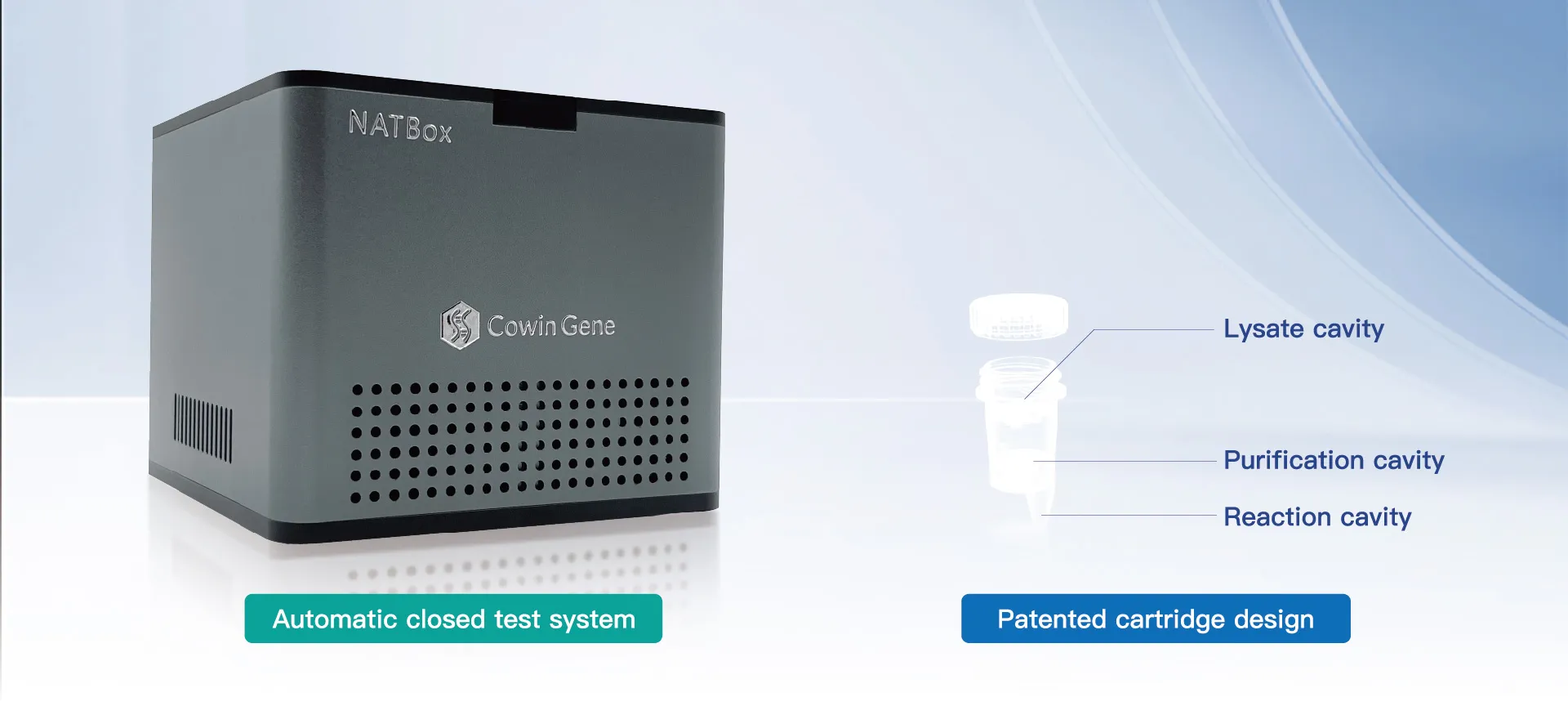
The Cowin Gene NATBox System Mini II is a portable, closed-cartridge real-time PCR platform that brings reference-lab molecular accuracy to the point of care. Lysis, purification, and amplification all occur inside a sealed disposable — eliminating the pre-PCR / post-PCR room infrastructure conventional workflows require. Sample-to-answer in a single closed workflow, one-touch operation, no molecular-biology specialisation needed.
The CE-IVD reagent menu spans HPV genotyping (the platform's flagship cervical-cancer-screening use), STI multiplex, respiratory panels (SARS-CoV-2 / Flu / RSV), GI pathogens, and MTB / MTB+NTM detection. The Mini II is mains-powered and handheld-class — refer to the Cowingene datasheet for instrument dimensions, weight, and per-run throughput.
JHS Analytic Traders is Cowingene's authorized distributor in Nepal — supplying the instrument and full reagent menu with operator training and ongoing technical support across Kathmandu, Pokhara, Biratnagar, and the rest of the country.
One Closed Cartridge. Three Chambers. Sample-to-Answer.
The NATBox cartridge integrates the entire molecular workflow inside a single sealed consumable. Once the sample is loaded, no operator intervention is required between extraction, purification, and amplification — and no sample or amplicon ever leaves the cartridge.
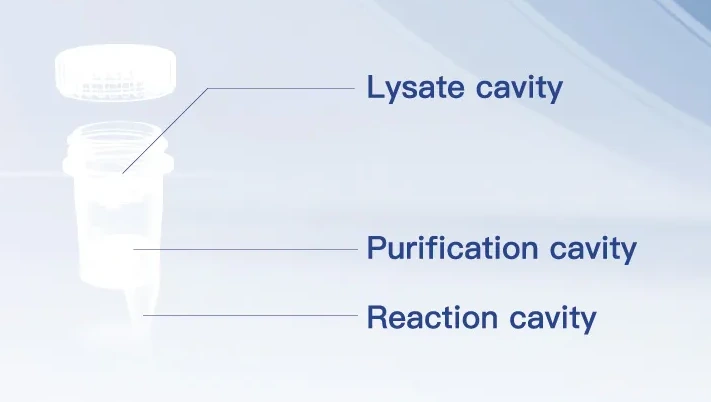
Lysate Cavity
Receives the patient sample — swab, sputum, plasma, serum, whole blood, CSF, urine, or other specimen. Lyses cells to release intracellular nucleic acids.
Purification Cavity
Isolates the target nucleic acids from inhibitors, proteins, and cellular debris. Delivers a clean, PCR-ready template downstream.
Reaction Cavity
Real-time fluorescence PCR — amplifies the target sequence and detects fluorescent signal in real time. Result automated by instrument software.
Decentralized Point-of-Care in Nepal
HPV-based cervical cancer screening is the platform's flagship Nepal application. Cervical cancer is the most common cancer among women in Nepal per the ICO/IARC Nepal Fact Sheet, and the WHO elimination strategy identifies high-coverage HPV testing as the primary screening method. With the NATBox, clinicians offer HPV testing in the same visit as the speculum exam.
The platform also runs STI multiplex, respiratory panels, GI pathogens, and MTB cartridges — clinic-scale throughput, not high-volume batch testing. (For accredited TB reference labs, WHO-prequalified platforms remain the primary recommendation.)
Clinical Settings & Use Cases
Women's Health & HPV Screening
Cervical cancer screening at primary care clinics, district hospitals, and women's health camps — same-visit HPV testing without referral to a reference lab.
District Hospitals
First molecular diagnostics capability for district hospitals that previously sent all samples to provincial or central labs.
Primary Care & OPD Triage
Same-visit STI and respiratory pathogen testing — diagnosis before the patient leaves the clinic, faster treatment decisions.
Rural & Outreach Programmes
INGO and government outreach in remote districts — molecular testing in mobile health camps where no laboratory exists.
Outbreak Response & Surveillance
Rapid field-deployable PCR for respiratory and GI outbreak investigation; surveillance programmes in border and high-risk areas.
Decentralized TB Triage
MTB / MTB+NTM detection in non-accredited primary and district settings — referral confirmation via WHO-prequalified platforms at reference labs.
The NATBox is one part of JHS's molecular diagnostics portfolio.
Whether configuring a women's health clinic, building decentralised molecular capability across a hospital network, or scaling a National HPV Screening programme — JHS supplies the full chain: instruments, reagents, biosafety cabinets, sample storage, training, and ongoing technical support.
Product documentation & media
Portable cartridge PCR for point-of-care molecular diagnostics.
What is the Cowin Gene NATBox System Mini II?
The Cowin Gene NATBox Mini II is a portable, cartridge-based real-time fluorescence PCR (NAAT) platform for point-of-care molecular diagnostics. A single closed three-chamber cartridge integrates sample lysis, nucleic acid purification, and real-time PCR amplification — eliminating the need for a dedicated molecular biology laboratory. The instrument is handheld-class with one-touch operation requiring minimal training. For exact dimensions, weight, and run time, please refer to the Cowingene datasheet.
What pathogens does the NATBox Mini II test for?
The NATBox menu spans multiple infection categories. The flagship application is HPV genotyping for cervical cancer screening, with multiple genotype panels available (HPV 16/18, 16/18/45, 6/11, and broader high-risk panels). Additional menu items include STI multiplex, respiratory pathogens (SARS-CoV-2, influenza, RSV), gastrointestinal pathogens, and Mycobacterium tuberculosis (MTB) and MTB + NTM detection. Test cartridges are sold separately and are CE-IVD marked.
Is the NATBox WHO-prequalified for TB diagnosis?
No. The NATBox is not WHO-prequalified for tuberculosis diagnosis. Currently the only rapid molecular TB tests with WHO prequalification are dedicated TB platforms from other manufacturers. The NATBox MTB cartridge is suitable for decentralized molecular TB testing in non-accredited and triage settings — primary health centres, district hospitals, and outreach programmes — but for accredited TB reference labs and National TB Programme procurement, WHO-prequalified platforms remain the primary recommendation.
Does the NATBox require a dedicated molecular biology lab?
No. The closed cartridge architecture eliminates the cross-contamination risk that drives the strict pre-PCR / post-PCR room separation conventional rt-PCR labs require. The NATBox can be deployed on any clinic bench, in primary care centres, in mobile health camps, and in field settings — with standard mains power and minimal infrastructure. This is the platform's core architectural advantage over conventional rt-PCR.
Where in Nepal is the NATBox best deployed?
The NATBox is purpose-built for decentralized point-of-care molecular testing — settings where sample transport to a central reference lab is not practical, where molecular biology infrastructure is not available, or where rapid on-site results are clinically required. In Nepal that includes: women's health and cervical cancer screening clinics (the flagship HPV use case), district hospitals running molecular diagnostics for the first time, primary care centres and outreach programmes in rural districts, INGO-funded health initiatives, and field deployment for outbreak response or surveillance.
Does JHS provide training, installation, and reagent supply?
Yes. As Cowingene's authorized distributor in Nepal, JHS Analytic Traders provides on-site installation, operator training (minimal — the platform is designed for one-touch operation), demonstration cartridges for validation, ongoing reagent and consumable supply through manufacturer-authorized channels, and technical support throughout the product lifecycle.